Interview
Hanqin Tang
CED Studio, United States
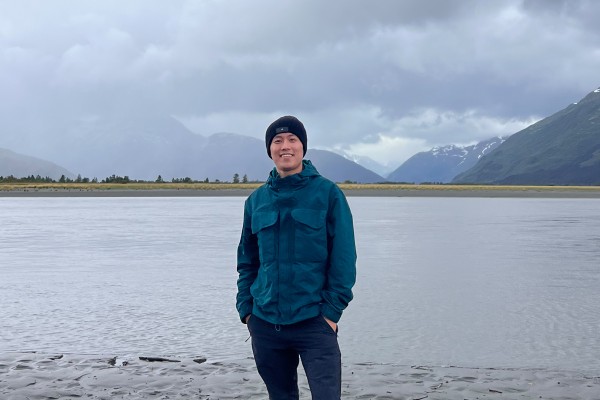
Hanqin Tang is an architectural designer and founder of CED Studio, where he investigates how architecture can express stories of change. His work explores the meeting point of technology, craft, and urban transformation through research and design experimentation.
1 Congratulations on winning in the TITAN Property Awards! Tell us more about your company, studio, or yourself.
Thank you! I’m an architectural designer and founder of CED Studio — a small design practice where I explore how architecture can capture stories of change. CED stands for Concept, Environment, and Detail — three words that shape everything I design. I started it as a space for experimentation, where ideas are allowed to stay playful before turning serious. I’m fascinated by how cities evolve, and how technology and craft can meet halfway to create spaces that feel both futuristic and deeply human.
2 Could you walk us through the concept and unique features of your award-winning project?
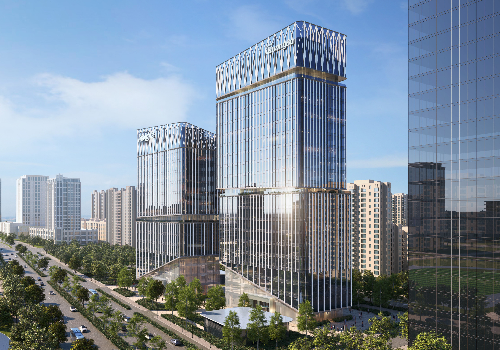
The Guangbo Headquarters Tower started from a simple question: how can a corporate tower feel alive? Instead of a sealed glass block, we designed two offset volumes connected by open sky gardens. These outdoor terraces create space for air, light, and social encounters high above the city. The towers lean gently toward each other, almost like two people in conversation — a subtle gesture that changes the light and wind patterns while giving the skyline its recognizable rhythm.
3 What do you believe makes this project stand out in the property industry?
It transforms an office tower into a vertical campus. Every few floors, people can step outside to a terrace, take a breath, and feel the city. The structure adapts to environmental forces while staying visually calm and clear. Instead of hiding systems behind glass, we let the performance become part of the architecture — that honesty gives the building character. It’s not trying to impress; it’s trying to connect.
4 What's the first thought that crossed your mind when you found out you had won in the award?
I laughed out loud — partly from joy, partly disbelief. I checked the email twice to make sure it wasn’t a promotional message. When I realized it was real, I just sat quietly for a few minutes, thinking about how this project began as a personal exploration with no big backing. It felt like the universe saying, “Keep going — your experiments matter.”
5 What's the inspiration or story behind your winning entry? Was there a meaningful moment during its creation that you would like to share?
Guangbo started as a stationery company — they made notebooks and pens. That detail stayed with me. I began sketching tower forms while literally flipping through a notebook, and I noticed how paper bends and catches light. The tower’s corner geometry was born from that curve. Later, the top crown was shaped like a sheet turning in the wind — a quiet nod to the company’s roots in paper and writing. That’s when the design clicked emotionally for me.
6 What was the most surprising or unexpected element of your entry's journey from concept to completion?
The structure turned out to resemble bamboo — strong, lightweight, and hollow at the center. It wasn’t intentional at first, but once the diagrid pattern appeared, it made perfect sense. We joked that the tower was “urban bamboo.” That playful moment reminded me that good design often hides inside the engineering — you just have to notice it.
7 Designing properties often requires balancing art and science. How do you harmonize aesthetics with functionality in your work?
I start with performance, then let intuition rearrange it. The fun begins when a technical decision suddenly creates beauty, like when a ventilation shaft becomes a skylight or a wind break becomes a sculpture. I love those moments when logic and emotion accidentally agree
8 What's the one challenge from this entry that you're most proud of overcoming?
Aligning the two offset towers structurally and vertically was brutal. Every small shift multiplied across 200 meters. I remember the moment the BIM model finally synced and all errors disappeared — it felt like solving a puzzle the size of a building. That sense of precision under pressure is addictive.
9 How do you think this recognition will impact your career or future projects?
It gives me courage to keep pushing boundaries as an independent designer. Awards are nice, but what matters most is the confidence they build — knowing that small studios can still shape big conversations. It also opened a few new collaborations, which I’m really excited about exploring next year.
10 How do you think your entry contributes to the future of property design and development?
It suggests that towers don’t have to be cold or anonymous. They can be social, porous, and emotionally expressive. I believe future property design will focus less on appearance and more on how buildings behave — how they move air, invite daylight, and make people feel present within the city.
11 Sustainability is an important topic in today’s world. How do you integrate eco-conscious practices into your projects?
I use digital tools to test daylight, material efficiency, and energy performance, but I also think about the human side of sustainability — how to make a place people truly care about. A building that people love will last longer than one that’s just efficient. The emotional durability is as vital as the technical one.
12 Are there any upcoming projects or ideas that you’re particularly excited about pursuing?
Yes — I’m currently developing a research project on how high-rise rooftops can function as small ecosystems rather than mechanical decks. I’m also experimenting with AI-assisted wind simulation to shape building envelopes dynamically. It’s messy and unpredictable, but that’s the fun part — seeing what happens when technology starts arguing with intuition.
13 If you could give one piece of advice to aspiring designers or developers entering the field today, what would it be?
Stay curious longer than everyone else. Don’t chase trends — chase your questions. Some of the best ideas come from side sketches or “failed” experiments. Keep a sense of humor, too. Architecture is serious work, but it doesn’t have to feel serious all the time.